



Earth’s polar regions serve as convergence zones for space weather energy input and represent the most direct and intense windows of response within the solar-terrestrial energy coupling chain. As China’s national ground-based monitoring array for space environment, the Meridian Project has established long-term, coordinated polar observation capabilities at key locations including Arctic field stations, Zhongshan Station, and Great Wall Station. This network enables multi-parameter synchronous measurements ranging from auroral particle precipitation and ionospheric drift to thermospheric wind fields. This unique configuration provides irreplaceable data support for systematically revealing the complete processes of energy injection, transport, and dissipation during extreme space weather events in polar regions.
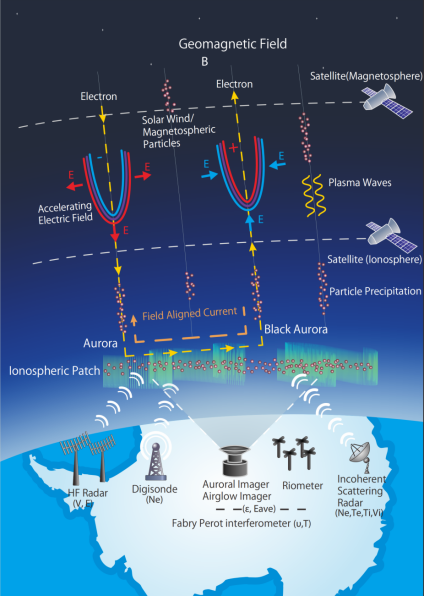
This special issue focuses on “Polar Space Environment Response” and aims to leverage radar, optical, and geomagnetic data accumulated by the Meridian Project to investigate frontier topics including polar ionosphere-thermosphere coupling mechanisms during magnetic storms, multi-scale atmospheric wave propagation characteristics, and conjugate effects. To promote data-driven interdisciplinary research, advance polar space physics from phenomenological description toward quantitative process understanding, and provide critical constraints for polar parameterization schemes in space weather numerical prediction models, Advances in Polar Science (APS) invites Dr. Zejun Hu, Dr. Zhiqing Chen, Dr. Xudong Gu, Dr. Zanyang Xing, and Dr. Xiangcai Chen to serve as Guest Editors for the special issue “Meridian Project Probes the Polar Region: Multi-Layer Coupling and Response of Space Environment”. We cordially invite you to contribute and recommend manuscripts for this special issue.
APS is an international, peer‑reviewed, open‑access journal sponsored by the Polar Research Institute of China (PRIC) and the Chinese Society for Oceanography (CSO). Since October 2025, it has been an AFoPS‑endorsed journal. Thanks to generous funding from PRIC, all articles are published free of charge. The journal is currently indexed in CSCD and Elsevier’s Scopus. We particularly welcome original papers from early‑career scientists. For more details, please visit our website: https://aps.chinare.org.cn
As this will be a scheduled special issue (Vol. 38 No. 2), there will be strict adherence to the following deadlines.
l 30 June 2026 — deadline for submitting abstracts of possible contributions;
l September 1, 2026 — deadline for submitting a manuscript for this issue;
l December 15, 2026— deadline for submission of the final accepted paper;
l December 30, 2026 — online publication date;
l June 30, 2027 — print publication date.
Submission Instructions:
(1) Manuscripts should be original and unpublished works, complying with the principles of academic integrity.
(2) Article types include Articles (research papers), Reviews, Opinion-Editorials (commentaries), Trends/Letters, etc.
(3) The limit extension for each manuscript is of 15 pages (about 10,000 words).
(4) Please prepare your manuscript according to the APS’s submission guidelines.
The themes of the special issue include, but are not limited to:
(1) Full-Process Responses to Extreme Space Weather Events
Investigating the two-dimensional structural evolution of polar ionospheric total electron content driven by CMEs or HSS (High-Speed Solar Wind Streams);
Studying the time-lag response of the thermosphere to auroral particle precipitation;
Generation and evolution of plasma patches in the polar cap region.
(2) Multi-Layer Coupling and Wave Propagation
Ionosphere-thermosphere-mesosphere momentum coupling in the polar regions;
Diagnostic identification of gravity waves in the auroral oval region;
Meridional circulation influences on polar–equatorial ionospheric anomalies.
(3) Data Assimilation and Intelligent Forecasting
Polar ionospheric reanalysis and background field correction based on Meridian Project data;
Preliminary construction of dynamic visualization for the polar space environment.
We sincerely invite you to contribute to this issue. If you are interested in this proposal, please send us or Editorial Office (journal@pric.org.cn) a tentative title, abstract, and the names of all possible co-authors. The submitted manuscripts will undergo a full peer-review process (through the Manuscripts Online System).
Guest Editors:
Dr. Zejun Hu, Polar Research Institute of China
Dr. Zhiqing Chen, National Space Science Center, Chinese Academy of Sciences,
Dr. Xudong Gu, Wuhan University
Dr. Zanyang Xing, Shandong University, Weihai
Dr. Xiangcai Chen, Polar Research Institute of China


 沪公网安备 31011502017260号